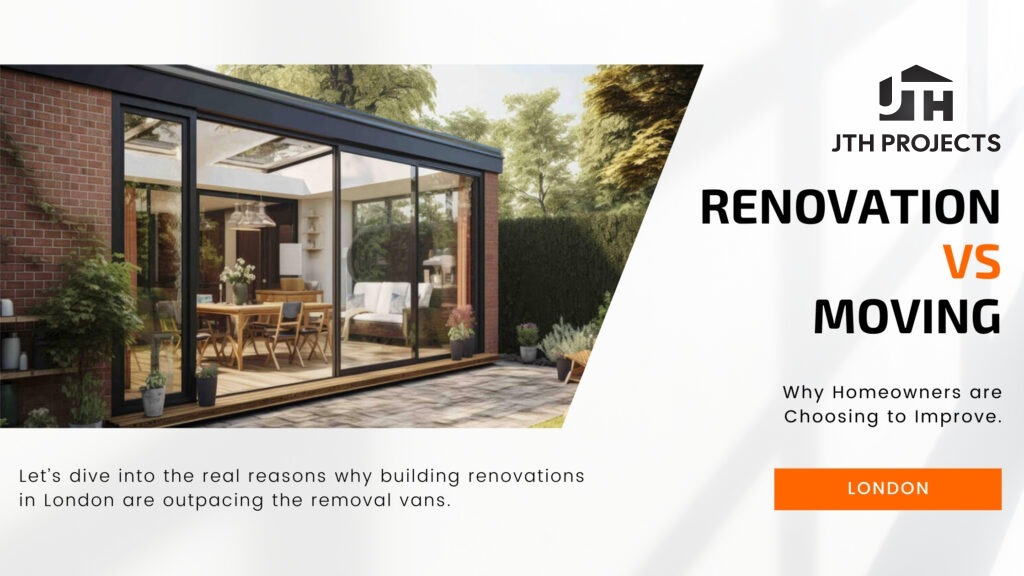
Stuck in the “move or improve” dilemma? Discover why Londoners are choosing building renovations over moving in 2025. Explore costs, value, and the secret perks of staying put. It’s the classic London dilemma, isn’t it?
You’re standing in your kitchen, waiting for the kettle to boil. You look around and think, “If only this room were just a few feet wider.” Or maybe you’re tripping over shoes in the hallway, dreaming of a loft conversion that magically swallows all the clutter.
For years, the default answer was simple: Sell up and move to Zone 4 (or 5… or 6).
But in 2025, the script has flipped. The “Renovation Renaissance” is here, and it’s reshaping streets from Ealing to Dulwich. Families are digging down, building up, and pushing out, transforming their current houses into forever homes.
Why the sudden shift? Is it just about love for the local pub, or does the maths actually stack up?
Let’s dive into the real reasons why building renovations in London are outpacing the removal vans.
The “Dead Money” Trap: Have You Done the Maths?
Let’s play a quick game. Grab a calculator (or just do a mental estimate).
If you were to buy a standard semi-detached house in London today—let’s say for £750,000—how much do you think you’d spend just to walk through the front door?
- Stamp Duty: ~£25,000 (and that’s if it’s your main home).
- Estate Agent Fees: ~£11,000 (at 1.5%).
- Legal Fees & Surveys: ~£2,500.
- Removals: ~£1,500.
Total “Dead Money”: £40,000+
That is forty thousand pounds vanishing into thin air. It doesn’t buy you a new kitchen. It doesn’t get you an extra bedroom. It just gets you the keys.
Now, imagine taking that same £40,000 and pouring it into your current home. That’s a stunning loft conversion shell, or a significant chunk of a rear extension.
According to recent data from Barbour ABI and the Office for National Statistics, renovation spending has surged, with median project spend rising by over 26% last year. Londoners are realising that instead of paying the taxman, they could be paying for a panoramic sliding door or a skylight that floods their breakfast table with sun.
Does Your Home Really Need to Change, or Just Grow?
We spoke to a marketing executive from Ealing, who faced this exact choice last year.
“We needed a third bedroom. The gap between our two-bed flat and a three-bed house in the same area was nearly £200,000. It felt impossible. Instead, we spent £65,000 on a loft conversion. We kept our neighbours, kept the kids in their school, and honestly, the new room is the best one in the house.”
This story isn’t unique. It highlights the emotional pull of staying put.
Moving house is widely cited as one of life’s most stressful events, right up there with divorce and job loss. By choosing to renovate, you avoid the “chain” falling through, the gazumping, and the heartache of packing boxes.
What Value Can You Actually Add?
This is the big question. If you spend money on building renovations in London, will you see it back?
While every street is different, the general rule of thumb for 2025 remains positive:
- Loft Conversion: Can add up to 20% to your property’s value.
- Kitchen Extension: Can add 10-15%, especially if it creates that coveted open-plan “family hub.”
- Extra Bathroom: An en-suite is often the tipping point for buyers, adding roughly 5%.
But value isn’t just monetary. It’s lifestyle value. It’s having a home office that isn’t the dining table. It’s having a garden room where you can actually hear yourself think.
The “Green” Bonus: Why 2025 is the Year to Retrofit
Here is a crispy fact for you: The government is currently offering 0% VAT on the installation of energy-saving materials until 2027.
That means if your renovation includes things like insulation, heat pumps, or solar panels, you are instantly saving 20% on the tax portion of those specific works. plus, with the new Warm Homes: Local Grant rolling out in 2025, eligible households can get funding for upgrades that lower bills forever.
Suddenly, that chilly Victorian terrace doesn’t seem so impossible to heat.
The 5-Minute “Move or Improve” Checklist
Are you still on the fence? Read through these five statements. If you nod your head to 3 or more, renovation is likely your winner.
- I love my area. (The commute is easy, the coffee is good, and I know my neighbours.)
- My garden is big enough. (I have space to extend out without losing all my green space.)
- I have an unused loft or garage. (This is “free” real estate waiting to be unlocked.)
- The “step up” in property price is daunting. (The next rung on the ladder costs £150k+ more than my current home.)
- I want a home that is uniquely MINE. (I don’t want someone else’s grey kitchen; I want my design.)
What About the Planning Nightmare?
“But isn’t getting planning permission in London a headache?” I hear you ask.
It can be. But it’s getting easier.
New Permitted Development (PD) rights updated for 2025 allow for larger rear extensions and more straightforward loft conversions without the need for a full planning application.
- Terraced House? You can often extend up to 6 metres to the rear.
- Detached? Up to 8 metres.
- Loft? Up to 40 cubic metres of additional roof space for terraced houses.
Of course, if you live in a Conservation Area (looking at you, Kensington & Chelsea), rules are stricter. But that’s where hiring the right team makes all the difference. You need experts who speak “council” fluently.
Ready to transform your London home?
At JTH Projects, we don’t just build walls; we build potential. We understand that a renovation isn’t just a project—it’s your life, your money, and your future.
Whether you need a complete home overhaul or a smart extension, our team of specialists is ready to guide you through every step, from the first sketch to the final coat of paint.
Contact JTH Projects today for a consultation. Let’s see what your home is really capable of.
FAQs
1. How much does a house renovation cost in London in 2025?
Costs vary wildly by finish, but a good benchmark is £1,500 – £3,000 per square metre for extensions. A standard loft conversion typically starts around £50,000. Remember to budget an extra 10-15% for unforeseen contingencies—London’s old houses love to hide surprises!
2. Do I need planning permission for a loft conversion?
Not always. Most loft conversions fall under “Permitted Development” rights, meaning you don’t need full planning permission as long as you stay within specific volume limits (40m³ for terraces, 50m³ for others). However, you will always need Building Regulations approval to ensure it’s safe.
3. Is it cheaper to extend up or out?
Generally, extending “up” (loft conversion) is cheaper per square metre than extending “out” (rear/side extension) because you aren’t laying new foundations. However, a kitchen extension often adds more “wow factor” and lifestyle value for families who want open-plan living.
4. How long does a typical renovation take?
Patience is key! A single-storey rear extension usually takes 3-4 months. A full house renovation can take 6-12 months depending on complexity. We always provide a detailed timeline before we start so you can plan your life (and your holidays!) around the build.
5. Can I live in the property during the renovation?
For smaller projects like a loft conversion, yes—though it will be dusty and noisy. For major structural renovations or whole-house retrofits, we often recommend moving out for a few weeks during the messiest phases (like demolition) to save your sanity.